Where esoteric wisdom meets the philosophy of mind
The Cosmic Doctrineof Dion Fortune
An Exegesis of Operative Cosmology
as Cognitive Engineering
A journey through symbols, consciousness, and the possibility that the worlds we contemplate can reshape the way we think.
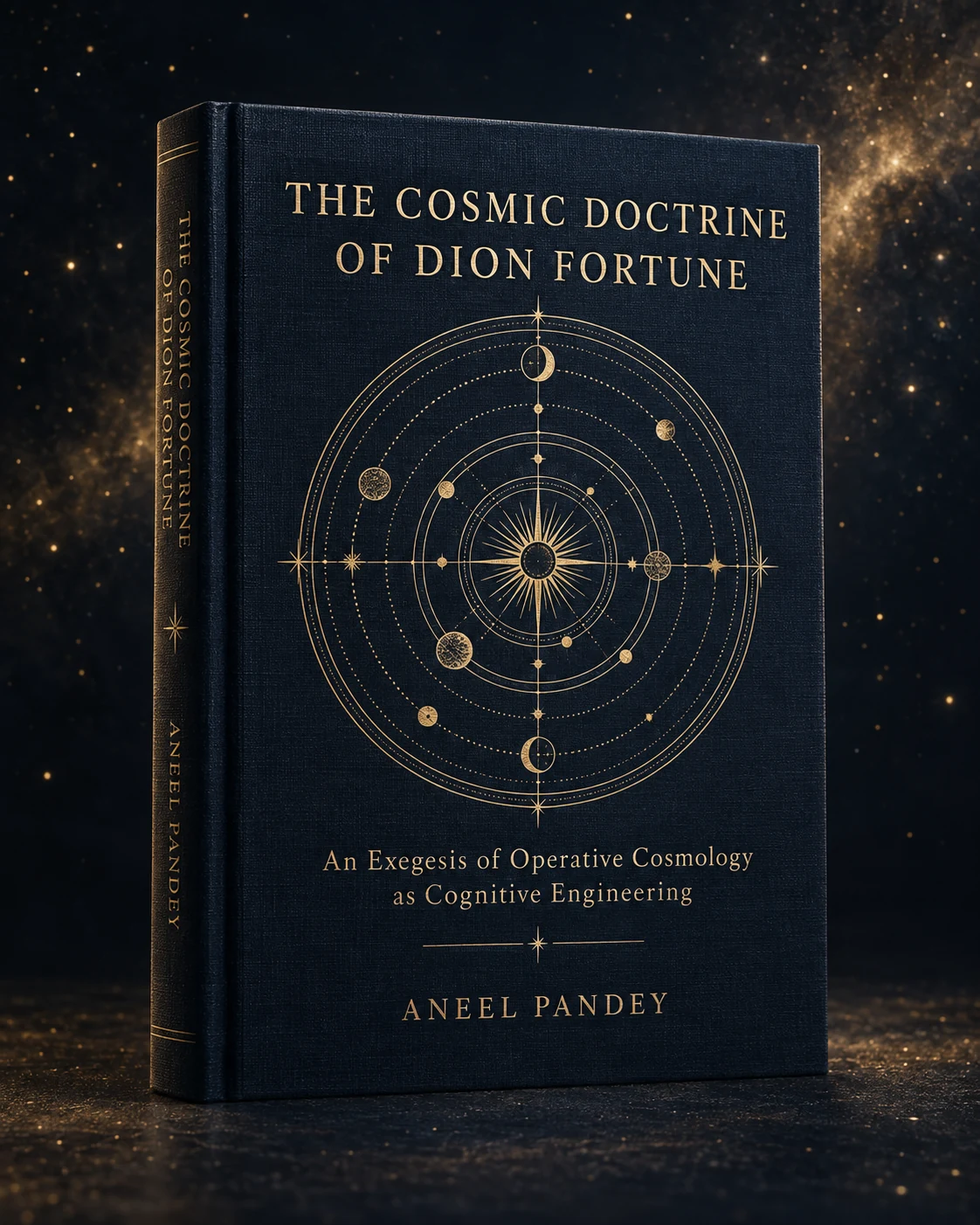
The idea at the heart of the book
What if a cosmology
could change the way
you think?
Aneel Pandey approaches Dion Fortune’s The Cosmic Doctrine as a training ground for the mind. Its Rings, Rays, and cosmic rhythms become an invitation to examine how symbols shape attention, perception, and imagination.
Across 43 chapters, this study places Fortune’s esoteric world in conversation with philosophy, psychology, and systems thinking. It follows a path from the origins of cosmic form to questions of memory, identity, responsibility, and integration.
For readers of Western esotericism and the philosophy of mind, the book offers a sustained, interpretive exploration of what it means to read a symbolic text as a practice.
The mythology is the method,
and the method is the mythology.
Inside the book
From the first motion
to the return to the center.
Explore the 43 chapters through five thematic paths.
01Learning to read differently
Chapters 1–7
Begin with the book’s central proposition: symbolic images can function as tools for thought. These chapters establish the historical, philosophical, and psychological foundations of that reading.
- 01Introduction: The Concealed Training Manual
- 02Dion Fortune and the Historical Field of British Esoteric Modernism
- 03Images as Tools: The Operative Epistemology of Esoteric Symbolism
- 04Motion, Rhythm, and Memory as Ontological Foundations
- 05Circles, Spirals, and the Moral Geometry of Change
- 06Psychology in the Mirror: The Interiorization of Cosmic Form
- 07The Grammar of Power: Pattern Recognition in an Age of Data
02The architecture of a cosmos
Chapters 8–16
Enter Fortune’s world of Rings, atoms, and great entities. Pandey traces the relationships between symbolic form, rhythm, memory, and the emergence of consciousness.
- 08The Primal Trinity: Ring Cosmos, Ring Chaos, and Ring Pass Not
- 09Tangentials, Atoms, and the Birth of Form
- 10From Atoms to Communities: Aggregation, Influence, and Scale
- 11Timing, Tides, and Cyclical Learning
- 12Great Organisms: Solar Systems as Living Geometry
- 13Multiplicity, Recursion, and Stellar Nurseries
- 14The Great Cosmic Clock: Days, Nights, and Sidereal Practice
- 15The Dawning Awareness of Great Entities
- 16Creation, Feedback, and Consciousness as Engineering
03From cosmic form to conscious mind
Chapters 17–26
Explore how the book connects evolution, feedback, individuality, and group consciousness, moving between the scale of a cosmos and the interior life of a person.
- 17Evolution Through Swarms and Reciprocal Consciousness
- 18Limitation, Precision, and the Ethics of Projection
- 19Feedback Loops and Practical Checkpoints
- 20Laws, Natural Order, and the Morphology of Epochs
- 21The Mirror Wheel: Projection, Return, and the Dynamics of Reciprocity
- 22Oversoul Grooves and the Phenomenology of Group Consciousness
- 23Individuality, Personality, and the Stratigraphy of Memory
- 24The Birth of Mind and Vehicles of Evolution
- 25Planetary Spirits and the Shaping of Worlds
- 26The Lords of Flame, Form, and Mind as Operational Laws
04Initiation, influence, and responsibility
Chapters 27–35
Follow the chapters on initiation, timing, and relations across different scales, including the ethical questions and dangers that accompany the pursuit of power.
- 27Initiation as Physics and the Mechanics of Cross-World Influence
- 28Seniors, Juniors, and the Mechanics of Initiation
- 29Relation at Scale: Group, Planetary, and Cosmic Reciprocity
- 30The Three Levels of Influence: A Reduction Kit
- 31Sidereal Practice: Tides, Rays, and Macro-Timing
- 32Dangers at the Nadir and the Left-Hand Path
- 33Great and Lesser Days of Brahma: Cosmic Governance
- 34Planes, Planetary Spirits, and Zodiacal Levers
- 35Cohabiting Evolutions and the Phenomenology of Psychism
05The movement toward integration
Chapters 36–43
The closing chapters bring education, limitation, polarity, and freedom into conversation with the book’s final themes: evolution, initiation, and love.
- 36Education by Impactation and Redeemer Lines
- 37Humanity—Latencies, Actualities, Potentialities
- 38Laws of Action, Reaction, and Limitation
- 39The Seven Deaths and the Ladder of Freedom
- 40Impactation and Polarity as Engines of Creation
- 41Outer Space: The Lure of Unconditioned Power
- 42The Attraction of the Center: True Integration
- 43Conclusion: Evolution, Initiation, and Love as Gravity
Begin reading
The concealed
training manual.
Step into the introduction and explore the distinction that guides the book: reading to gain information, and reading to cultivate a way of thinking.
A passage from chapter one
“This study is animated by a methodological commitment that may be stated most concisely as follows: to read Fortune’s cosmology as psychology in a mirror, her physics as a training grammar, and her mythology as a gymnasium for the imagination.”
From §1.3.3 · Methodological Commitments